

Waking at night with a numb hand, feeling tingling in the fingers, or shaking the hand to ease the sensation are experiences many people describe.
One possible cause is carpal tunnel syndrome, which involves compression of the median nerve as it passes through the wrist. But tingling does not automatically mean carpal tunnel syndrome—and people with the diagnosis do not all need the same treatment.
Laser therapy, including low-level and high-intensity systems, has been studied as a conservative option. What does the research actually show?
What is carpal tunnel syndrome?
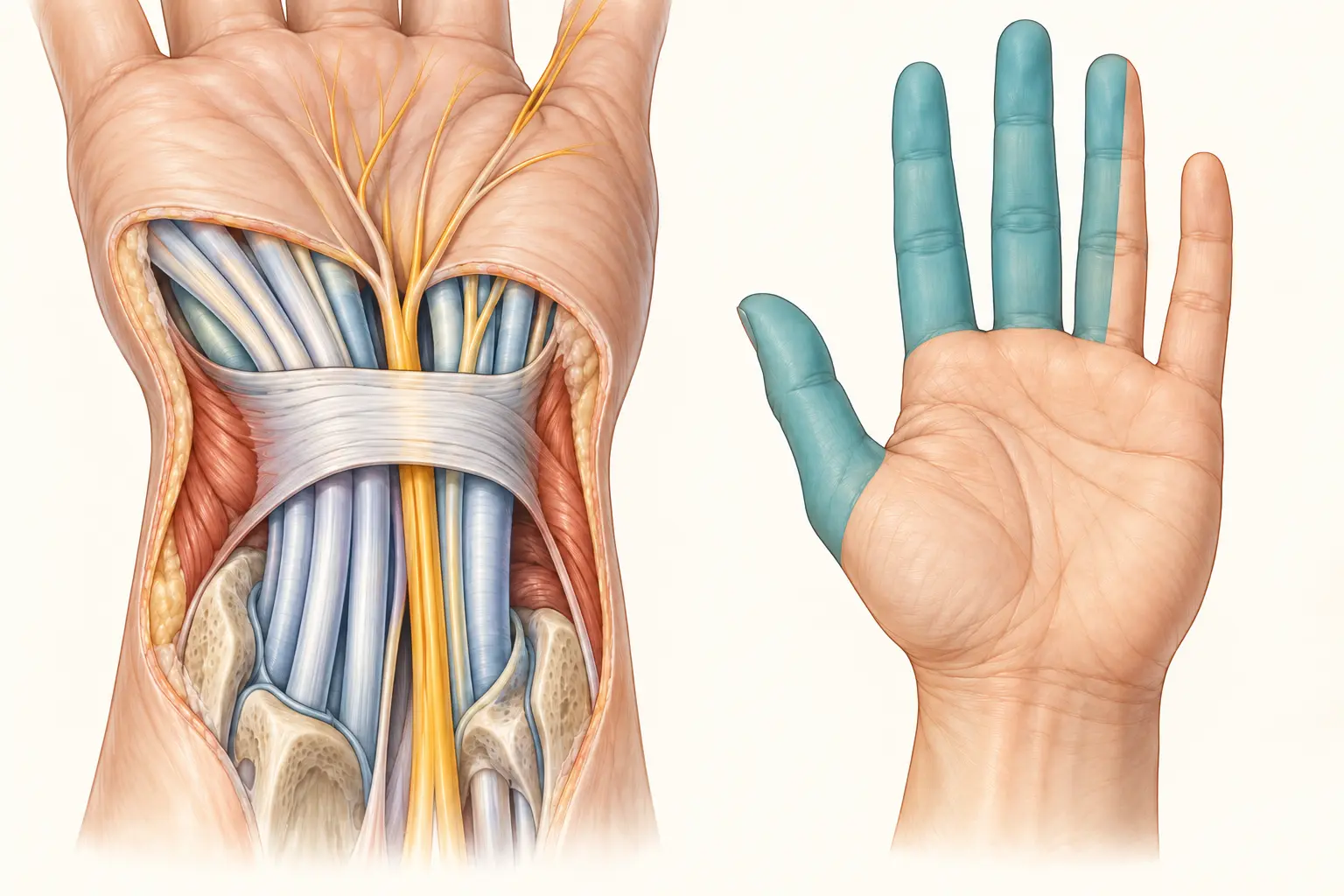
The carpal tunnel is a relatively narrow passage in the wrist. Tendons and the median nerve pass through it. The median nerve contributes to sensation in part of the hand and to some muscle functions. Pressure on the nerve in the tunnel may cause symptoms such as:
- Tingling or numbness in the hand.
- Wrist pain or discomfort that may extend toward the forearm.
- Altered sensation in some fingers.
- Hand weakness or difficulty with certain thumb movements.
- Symptoms that are often more noticeable at night.
Some people wake up and need to move or shake their hand to ease the discomfort.
Which fingers may feel numb?
The median nerve mainly supplies sensation to the thumb, index finger, middle finger, and part of the ring finger. The pattern can help during a clinical assessment.
However, neck problems, other peripheral nerves, and musculoskeletal conditions can also cause pain, tingling, or altered sensation in the hand. “My hand goes numb” describes a symptom, not a diagnosis.
Why can symptoms be worse at night?
Prolonged wrist positions during sleep may increase pressure in the tunnel and bring on symptoms. This is one reason wrist splints—often worn at night—appear in conservative treatment strategies.
Some laser trials used laser together with a wrist splint, rather than on its own.
Does carpal tunnel syndrome always require surgery?
No. Treatment depends on symptom severity, how long symptoms have been present, and how much the nerve is affected. Conservative options may be considered in selected people with mild or moderate symptoms. When nerve involvement is more significant or conservative care is not adequate, other options—including surgery—may be discussed.
The evidence review by Papanikolaou and colleagues examined laser therapy in this conservative-care context. Determining the degree of median nerve involvement is important before choosing an approach.
What role might laser therapy have?
Laser therapy delivers light energy that interacts with tissue. As discussed in our overview of high-intensity laser therapy, some wavelengths have been studied for photobiomodulation and possible effects on cellular metabolism, inflammatory signaling, and mechanisms involved in pain perception.
For carpal tunnel syndrome, studies have examined pain, symptom severity, hand function, pinch strength, and some median nerve conduction measures. But the answer is not simply “yes, it works.” Results vary with the type of laser and its parameters.
What did the review find?
Papanikolaou and colleagues reviewed 10 publications, including clinical studies and systematic reviews of laser use for carpal tunnel syndrome. The research included low-level and high-power or high-intensity laser approaches.
The authors concluded that laser therapy appeared to have a positive effect on some symptoms, while highlighting a major limitation: protocols differed substantially in power, energy, wavelength, and number of sessions. That variability makes it difficult to compare results or identify a single best protocol.
What do studies say specifically about high-intensity laser?
One study in the review directly compared a wrist splint alone, a splint plus low-level laser, and a splint plus high-power laser in 45 people with mild or moderate carpal tunnel syndrome.
All three groups improved on some measures. The laser-plus-splint groups showed greater improvements in pain, function, and pinch strength than the splint-only group. However, that trial did not find a significant difference between high- and low-power laser. A more powerful laser did not automatically produce better results.
Another study included 98 people and compared different energy levels of low- and high-intensity laser. Researchers measured pain and some electrodiagnostic parameters of the median nerve. Improvements were reported with different laser approaches; one HILT protocol had better results on pain and electrodiagnostic measures than the other groups.
This result also points to the importance of protocol and dose. It does not support saying that high-intensity laser always works better.
Can laser improve hand function or repair the nerve?
Some studies reported favorable changes in hand function, pinch strength, symptom severity, pain, or nerve-conduction measures. Those outcomes do not prove that laser therapy repairs the median nerve or removes the cause of compression.
The review also found that, although some studies reported favorable results compared with placebo, superiority over other treatment approaches was not conclusively established. Study quality, different protocols, and follow-up periods limit the conclusions.
How many sessions are needed?
There is no universal number. Research schedules differ, and a protocol used in a study should not automatically be applied to an individual. Diagnosis, symptom severity, nerve involvement, other care, and response to treatment all matter.
When should symptoms be assessed?
Seek an assessment if numbness or tingling persists, worsens, disrupts sleep or daily activities, or is accompanied by increasing weakness or difficulty using the hand. Similar symptoms can have different causes, so an evaluation is important before choosing treatment.
The takeaway
Research suggests laser therapy may improve some symptoms for some people, but findings vary, protocols are inconsistent, and the evidence does not establish it as a cure or a replacement for other care. The decision should follow an individual assessment and account for the cause and severity of symptoms.
Main reference
Papanikolaou A, Iakovidis P, Lytras D, Kottaras I, Kottaras A, Chasapis G. The effect of laser therapy on the treatment of carpal tunnel syndrome symptoms. National Journal of Clinical Orthopaedics. 2021;5(2):30–33. doi:10.33545/orthor.2021.v5.i2a.280.
Suggested next step: Request an assessment if you would like to discuss your case.