

Reaching overhead, getting dressed, driving, carrying a bag, or sleeping on one side can become difficult when shoulder pain persists. While many episodes improve, pain lasting weeks or months deserves an assessment to understand its cause and discuss suitable options.
High-intensity laser therapy (HILT) is one modality studied in conservative care for some musculoskeletal problems. A clinical study compared it with therapeutic ultrasound in people with chronic shoulder pain. What did the researchers find?
Why can shoulder pain last?
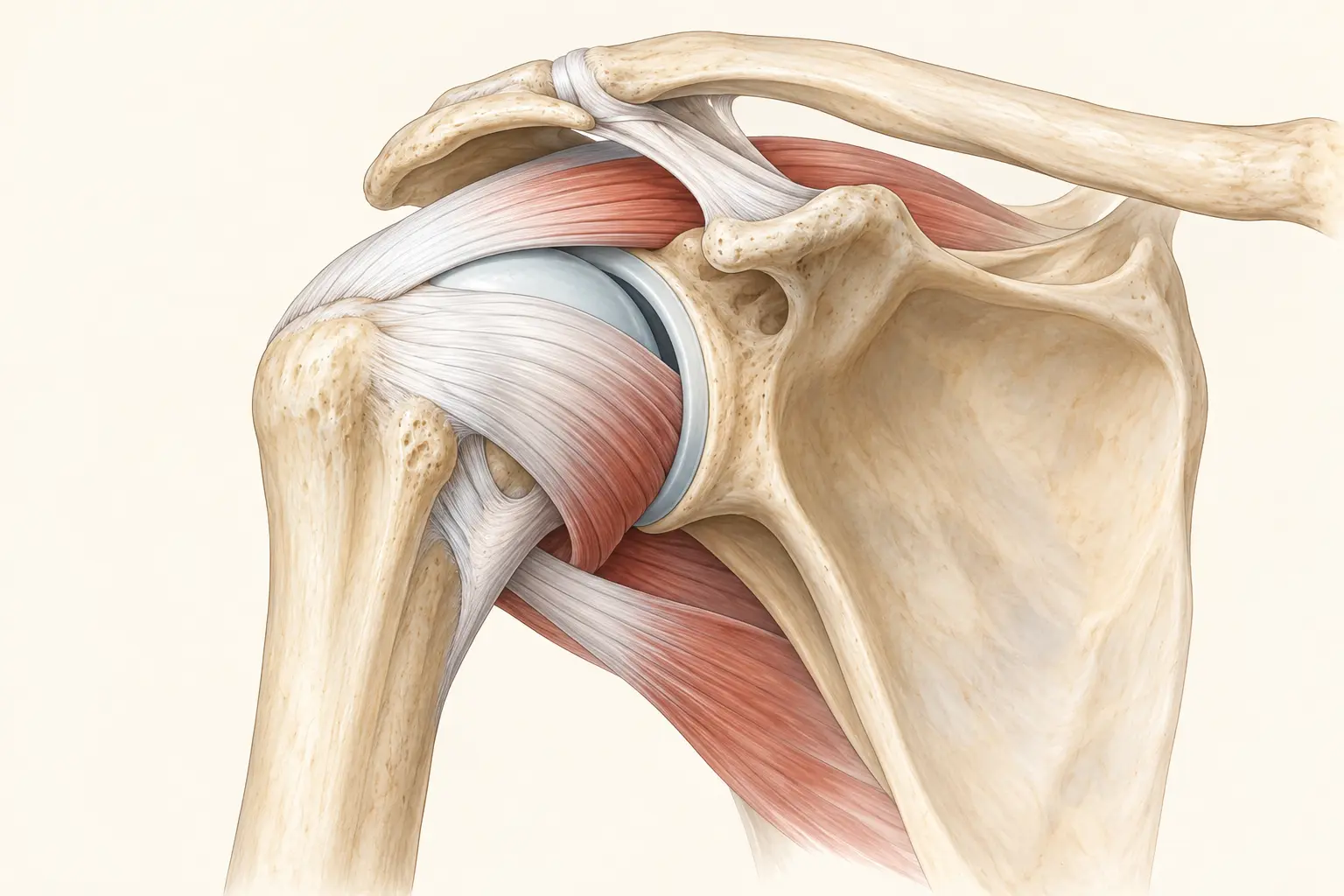
The shoulder has a wide range of motion and relies on muscles, tendons, and other structures. “Shoulder pain” by itself is not a diagnosis. Possible causes include rotator cuff disorders, subacromial pain, tendinopathy, frozen shoulder, calcific tendinitis, and degenerative conditions.
Some people mainly hurt when raising an arm; others have night pain, difficulty dressing, or gradually reduced movement. Identifying the cause is important before choosing treatment.
What did “chronic” mean in the study?
The study discussed in this article included people aged 35 to 75 who had shoulder pain for more than three months. All participants had been diagnosed with subacromial impingement syndrome.
This matters: the findings should not be treated as evidence that laser therapy works in the same way for every cause of shoulder pain.
What is subacromial impingement syndrome?
The term has been used for shoulder pain associated with certain movements, particularly raising the arm. Symptoms can include pain when lifting an arm or reaching overhead, difficulty dressing, night pain, and loss of strength or movement due to pain.
Similar symptoms can occur with other shoulder conditions. Pain location alone is not enough to establish a diagnosis.
What did the clinical study compare?
Ökmen and colleagues conducted a prospective, randomized, controlled, single-blind study. 141 people with chronic shoulder pain and subacromial impingement completed the study:
- 70 received therapeutic ultrasound.
- 71 received high-intensity laser therapy.
Neither group received only a device treatment. Both also received other physical modalities and a program involving mobility, stretching, and strengthening exercises. The study therefore compared HILT with ultrasound as additions to a treatment program, not as stand-alone treatments.
How were outcomes measured?
Researchers assessed pain with a visual pain scale and shoulder pain and disability with the Shoulder Pain and Disability Index (SPADI). Participants were evaluated before treatment, immediately afterward, and again about one month later.
What happened?
Both groups improved in pain and function. When the researchers compared the groups, they reported better results in the HILT group at the end of treatment and at follow-up.
For example, the pain score in the HILT group changed from about 66 before treatment to 27 at follow-up. In the ultrasound group it changed from about 69 to 42. The study also reported differences in pain and disability measurements.
These numbers describe the participants in that study; they are not a prediction of what another person will experience.
Does this prove laser is always better than ultrasound?
No. The study found better short-term results with HILT under its specific conditions. The authors also noted important limitations: there was no placebo group, and follow-up was relatively short.
The findings support describing a short-term advantage observed in that group—not claiming HILT is superior for every type of shoulder pain or that the effects necessarily last long term.
Does laser therapy replace rehabilitation?
No. Participants performed exercises to restore movement and strengthen the shoulder while receiving their assigned modality. The device treatment was a complement, not a replacement for exercise and rehabilitation.
Pain reduction may help someone move more comfortably, but regaining function and returning to activities also matter.
Is HILT appropriate for every shoulder problem?
The study cannot answer that. It focused on people with a particular diagnosis and excluded other conditions, such as frozen shoulder and pain originating in the neck. The conclusions should not be generalized to every person with shoulder pain.
A clinical assessment helps determine the cause, identify warning signs, and decide whether a particular treatment belongs in the plan.
How many sessions does a shoulder need?
There is no one schedule that fits every person or condition. Study protocols are not automatically prescriptions for an individual. The plan should be based on diagnosis, symptoms, function, response to treatment, and the clinician’s judgment.
What can a patient reasonably expect?
The study suggests that HILT, when combined with other modalities and exercise, may be considered for selected people with chronic shoulder pain and subacromial impingement. It does not prove that HILT cures the condition, repairs a tendon, or guarantees pain relief.
If shoulder symptoms persist or limit daily activities, an assessment can help clarify the cause and appropriate options. HILT may be considered only as a complementary approach when clinically suitable.
Scientific reference
Metin Ökmen B, Ökmen K, Özkuk K, Uysal B, Sezer R, Koyuncu E. Comparison of the Efficacy of High Intensity Laser and Ultrasound Therapies in Chronic Shoulder Pain; Randomized Controlled Single Blind Study. J PMR Sci. 2017;20(2):57–65.
Suggested next step: Request an assessment if you would like to discuss your case.