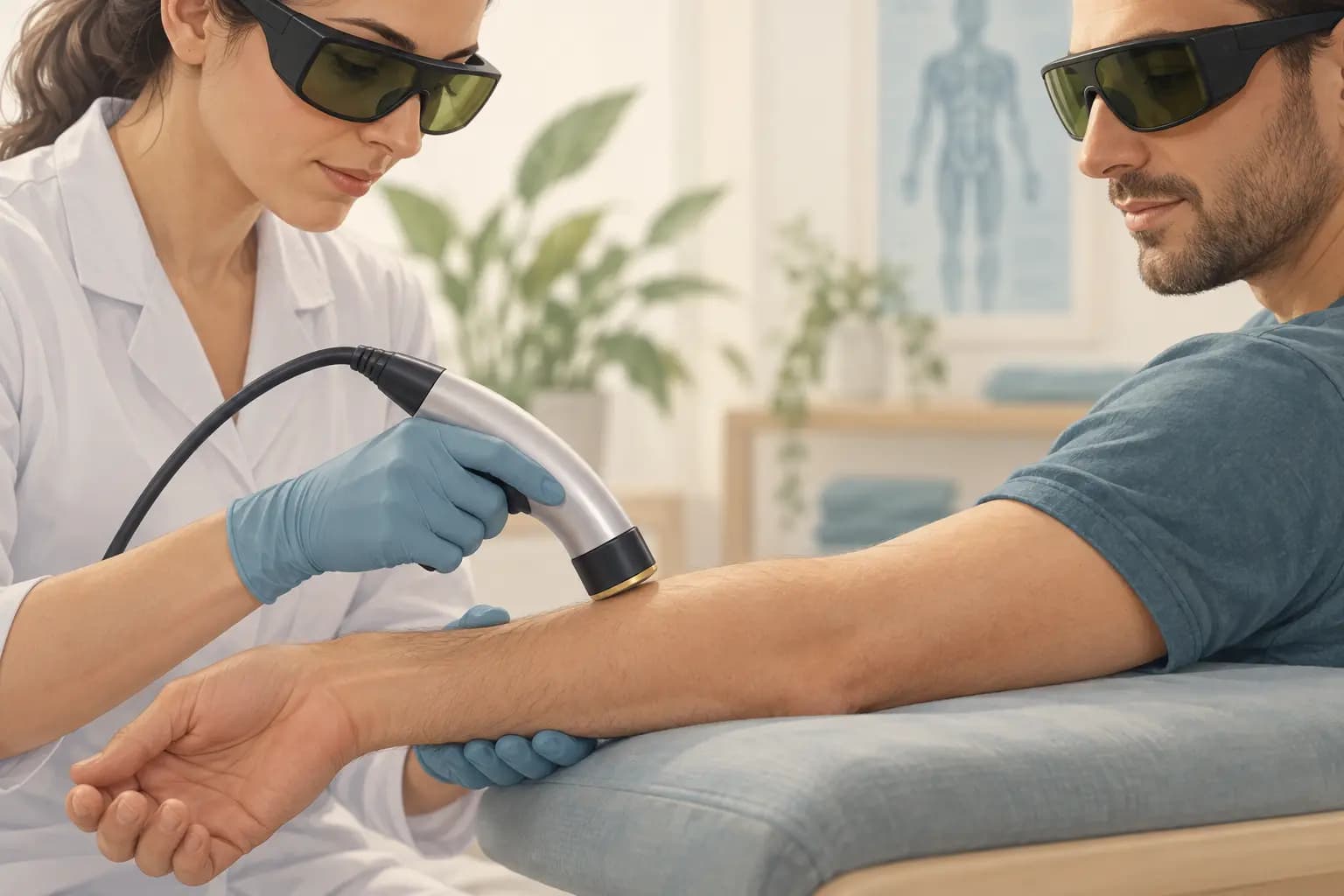
The word laser can bring to mind cutting, burning, or destroying tissue. Therapeutic lasers are used for a different purpose: they deliver light energy to a selected area in a controlled way.
High-intensity laser therapy (HILT) has been studied as a complementary approach to pain management and rehabilitation. It is not a surgical laser, does not introduce medication into the body, and should not be described as a cure.
So what happens when therapeutic light reaches tissue?
A therapeutic laser is still light
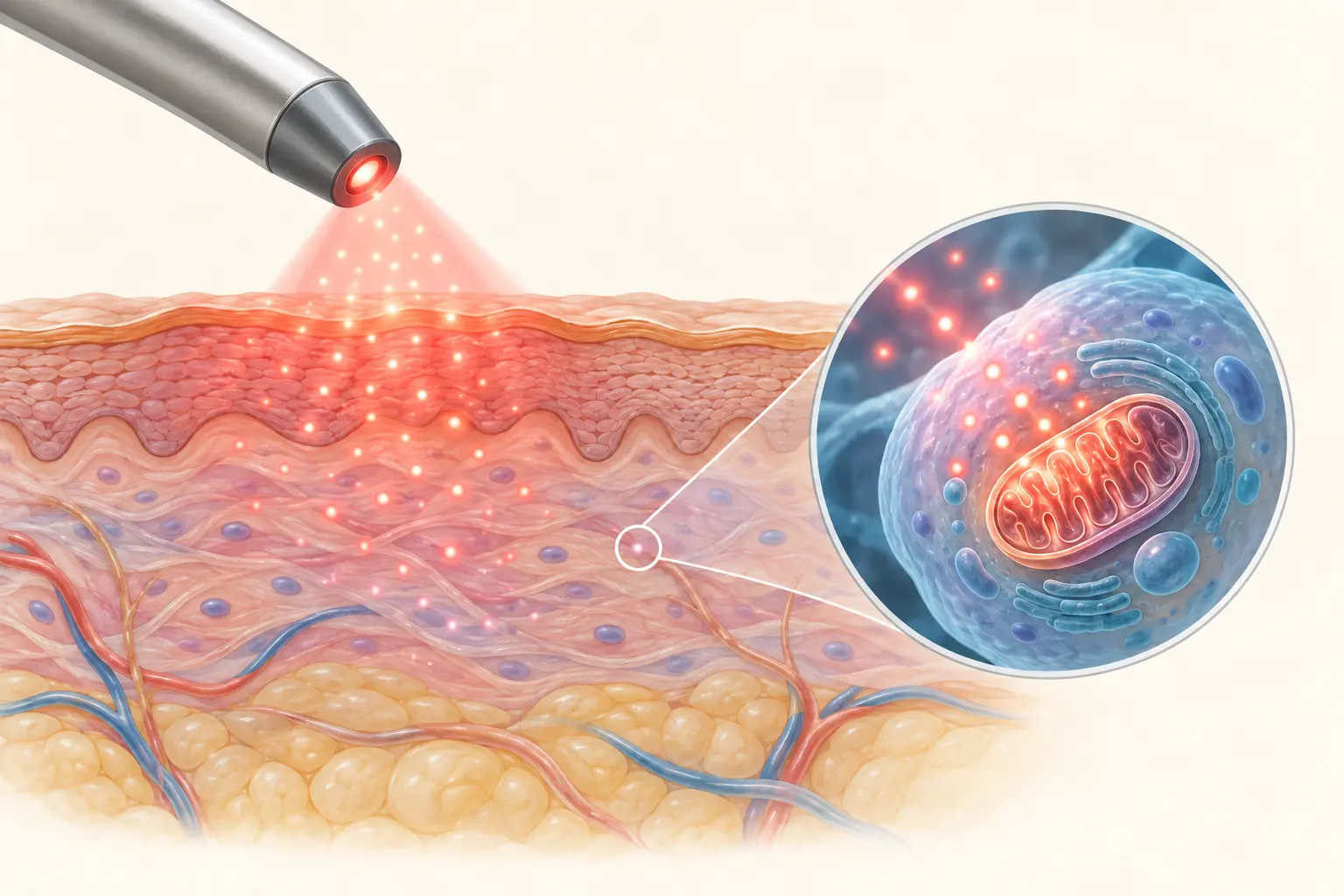
Light is a form of energy. A therapeutic device emits light at selected wavelengths. At the skin, some light is reflected or scattered; some may be absorbed by structures in the tissue. The interaction depends on the wavelength, delivered energy, treatment area, exposure time, emission mode, tissue characteristics, and application technique.
In simplified form:
Light → tissue → cells → biological response
The device does not add a new substance to the body. It delivers light energy that may interact with biological processes already present in cells.
What may happen when light reaches cells?
Mitochondria are structures inside cells that take part in producing ATP (adenosine triphosphate), one of the molecules cells use for energy. A leading hypothesis in photobiomodulation research is that certain wavelengths interact with molecules involved in mitochondrial activity, including an enzyme called cytochrome c oxidase.
These interactions may affect pathways involving ATP, nitric oxide, reactive oxygen species, intracellular calcium, and cell signaling. The mechanisms are still being studied. Cytochrome c oxidase is one of the most researched explanations, but it is not a complete or settled account of how photobiomodulation works.
What does photobiomodulation mean?
The word can be broken down simply:
- Photo means light.
- Bio refers to biological processes.
- Modulation means influencing or regulating a response.
Photobiomodulation is the use of light to influence certain biological processes. It does not mean forcing a cell to do something entirely new. This is why “modulating cellular processes” is more accurate than saying that a laser simply “gives energy to cells.” Any change in ATP would be only one part of a larger chain of cellular signals.
How might laser therapy relate to pain?
Pain is more complex than a signal from an injured area. Nerve endings, inflammatory mediators, the nervous system, and the way the body processes signals can all be involved.
HILT has been studied for possible effects on pain perception through photobiomodulation, neural mechanisms, and changes in signaling related to inflammation. A careful description is that it may contribute to pain modulation—not that it “switches pain off.”
What about inflammation?
Inflammation is part of the body’s normal response to injury or stress; it is not always harmful. Some inflammatory signals may, however, be involved in persistent pain and changes in function.
Laboratory and clinical research has associated photobiomodulation with changes in cell signaling, nitric oxide, redox balance, and other pathways involved in inflammatory responses. “Modulation of processes related to inflammation” is more precise than claiming that laser therapy simply “reduces inflammation.”
What is different about a high-intensity laser?
HILT systems can deliver relatively high amounts of energy over shorter periods than lower-power systems. That does not automatically mean that light reaches a specific depth or that higher power is better.
How energy is distributed depends on several factors:
- Wavelength and power.
- The energy delivered and treatment time.
- The size of the treated area.
- Continuous or pulsed emission.
- Tissue characteristics and application technique.
Protocols used in HILT research vary. This makes comparisons between studies difficult and is one reason uncertainty remains about the best parameters for different conditions.
Does more power mean better results?
No. The equation is not simply more power = more benefit. The response depends on how much energy is delivered, how it is delivered, for how long, and to which tissue. A device’s wattage alone does not establish whether treatment is appropriate or what outcome to expect.
Can HILT produce warmth?
A person may feel controlled warmth, depending on the device, selected parameters, and treatment area. The goal is not to burn or destroy tissue. A surgical laser is designed for effects such as cutting, coagulation, or ablation; musculoskeletal laser therapy has a different, non-surgical purpose.
Sensations vary. With some high-intensity systems, a person may notice warmth as the applicator moves over the area. Application should be controlled, use the required safety measures, and be adjusted to the protocol and the person’s tolerance. Tell the treating professional if the sensation becomes uncomfortable.
Does laser therapy improve circulation or repair tissue?
Light-based therapies have been studied for effects on blood flow and biological responses involved in tissue repair. However, a proposed mechanism or a laboratory finding does not prove that a treatment restores normal circulation, repairs a specific injury, or produces the same result in every person.
It is more responsible to say that HILT is being studied for possible biological effects than to promise tissue regeneration. A symptom change does not necessarily mean that an underlying structure has been repaired.
What is it used for—and does it work on every kind of pain?
Research has explored therapeutic laser as a complement in selected musculoskeletal and painful conditions. Results depend on the condition, treatment protocol, study design, and other care a person receives. Pain in the same body region can have different causes, so the name of a symptom alone is not enough to decide whether HILT is suitable.
Assessment and diagnosis matter. HILT should not replace medical evaluation, rehabilitation, exercise, medication, or other treatment recommended for a person’s condition. It may be considered as one component of an individualized plan when a qualified professional determines that it is appropriate.
The practical takeaway
Therapeutic laser delivers light energy that can interact with tissue. Photobiomodulation research proposes several possible cellular pathways, but the exact mechanisms and clinical effects continue to be investigated.
HILT is not a surgical laser, more power does not guarantee a better result, and the treatment is not a cure. The indication, parameters, and the person’s overall care plan matter as much as the equipment.
If pain is limiting your activities, seek an assessment to understand its cause and discuss suitable options. HILT may be considered only as a complementary approach for selected cases.
Scientific references
- PubMed: PMID 32716711
- PubMed: PMID 29164625
- PubMed: PMID 36836014
- PubMed: PMID 39652213
- PubMed: PMID 41697446
Suggested next step: Request an assessment if you would like to discuss your case.